
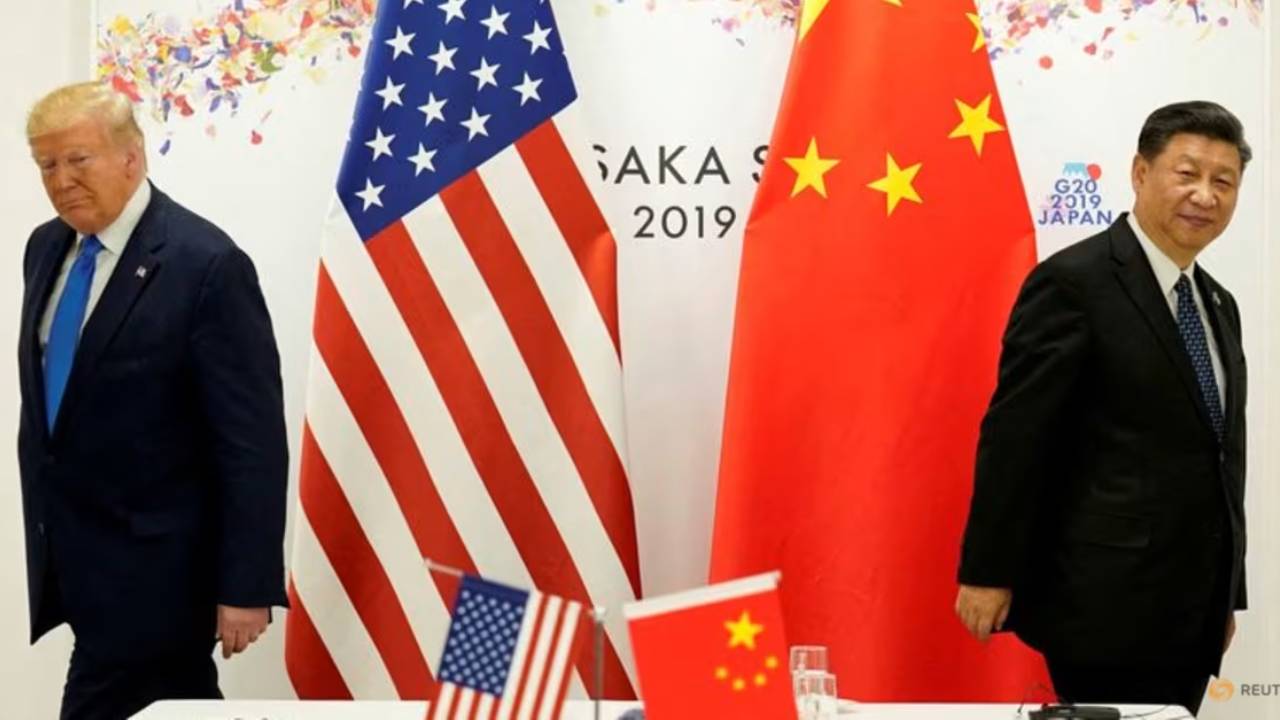
WASHINGTON — Trade Truce Shattered as US-China Tensions Escalate
US President Donald Trump reignited the long-standing trade war with China on Friday, abruptly ending months of fragile calm between the world’s two largest economies.
In a dramatic policy reversal, Trump announced new 100% tariffs on Chinese exports to the US and fresh export controls on all “critical software” effective November 1, just nine days before current tariff relief was set to expire.
The move comes in retaliation for China’s decision to expand its rare earth export controls, a sector in which Beijing holds near-total dominance.
Trump Cancels Trade Meeting With Xi Jinping
The announcement also threw doubt over a planned meeting between Trump and Chinese President Xi Jinping scheduled for later this month in South Korea.
Posting on Truth Social, Trump wrote,
“Now there seems to be no reason to do so.”
He later told reporters that while the meeting was not officially cancelled, “I would assume we might have it.” Beijing, however, has not confirmed the meeting.
Beijing’s Rare Earth Move Sparks US Reaction
China recently broadened its rare earth element export controls, adding five new elements and dozens of refining technologies to its restricted list.
Rare earths are essential components in everything from electric vehicles and smartphones to military radars and aircraft engines.
Trump described China’s move as “very bad” and “shocking,” adding:
“For every element they have monopolized, we have two.”
Analysts say Washington viewed the expansion as a direct provocation, despite Beijing’s claim that the measures were not targeted at the US specifically.
Markets Reel as Trade Tensions Flare
Trump’s sudden escalation sent global markets into a tailspin.
The S&P 500 Index fell more than 2%, marking its steepest one-day drop since April, as traders fled to gold and US Treasury securities. The US dollar also weakened against major currencies.
Technology stocks were particularly hard hit, as the new export controls could severely impact cloud computing and AI firms dependent on the Chinese market.
“Trump’s post could mark the beginning of the end of the tariff truce,” said Craig Singleton, a senior fellow at the Foundation for Defense of Democracies.
“Beijing appears to have overplayed its hand.”
New Export Restrictions Loom
In addition to software, Trump signaled possible new export restrictions on airplanes and parts, with sources suggesting that further trade penalties are being drafted.
Meanwhile, the US Federal Communications Commission (FCC) confirmed that major online retail platforms had removed millions of listings for banned Chinese electronics.
Separately, the Trump administration also proposed banning Chinese airlines from flying over Russian airspace on routes to and from the US — an unprecedented move further straining diplomatic ties.
A Trade Relationship on the Brink
Economists warn that this renewed escalation could unravel months of painstaking diplomacy aimed at stabilizing relations between Washington and Beijing.
“They both are hoping that amping up pressure will lead the other to make concessions in advance of APEC,” said Scott Kennedy of the Center for Strategic and International Studies.
“Or they’ve already decided that a deal is impossible and are building leverage for the next round.”
As the Asia-Pacific Economic Cooperation (APEC) forum approaches on October 31, the possibility of a Trump–Xi meeting now hangs in the balance — and with it, the fragile economic détente between the world’s two largest powers.